


Author: Chris Pike
Translated and adapted by: Pacharapol Kangla
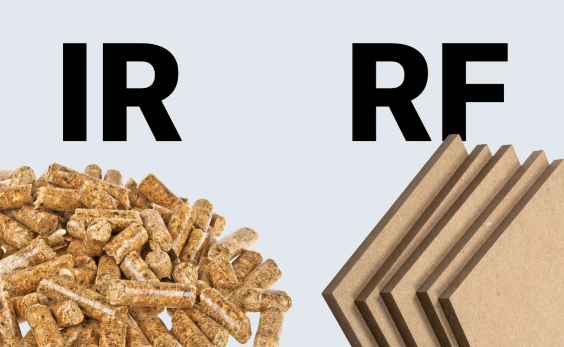
When it comes to techniques for analyzing and measuring moisture, one of the key aspects not to be overlooked is accuracy. Both Near Infrared (NIR) and Radio Frequency (RF) technologies provide high levels of accuracy. But which technique is more suitable for which application? This article has the answer.

Near Infrared (NIR) Technology
Near Infrared technology measures moisture on the surface of an object. The accuracy depends on how evenly the moisture is distributed across the product. The more uniform the distribution is, the closer the measured values will be to the actual average.
Therefore, this technique is best suited for production lines handling small-sized products, such as powders, crushed minerals, rocks, soil, sand, glass scrap, plastic scrap, plastic pellets (PET, PVC), wood chips for fuel, seeds, rice, flour, sugar, animal feed, ash, and sludge.
In addition, NIR can also be used to measure the distribution of certain substances on smooth surfaces — for example, the adhesive layer on tapes, stickers, or textiles.
If you are still uncertain whether Near Infrared technology is the right choice, you can contact us at Melchers Thailand.
Radio Frequency (RF) Technology
Radio Frequency technology measures moisture using a penetration method, based on differences in the electrical properties of insulating materials. This allows for analysis of the moisture content within the entire sample.
The main advantage of this method is that it can measure the moisture inside the whole product, providing high accuracy. However, the results depend on the uniform density of the sample. This makes RF particularly suitable for flat sheet materials, such as wood boards, plywood, cement/fiber boards, Medium Density Fiberboard (MDF), High Moisture Resistance boards (HMR), gypsum, paper, and textiles.
When choosing the right technology for moisture analysis, other factors must also be considered, such as cost-effectiveness, maintenance requirements, and temperature.
For more information on these products, please visit KPM Analytics or contact Melchers Thailand.
Original article: IR vs. RF Technology


 English
  Thai
Thai